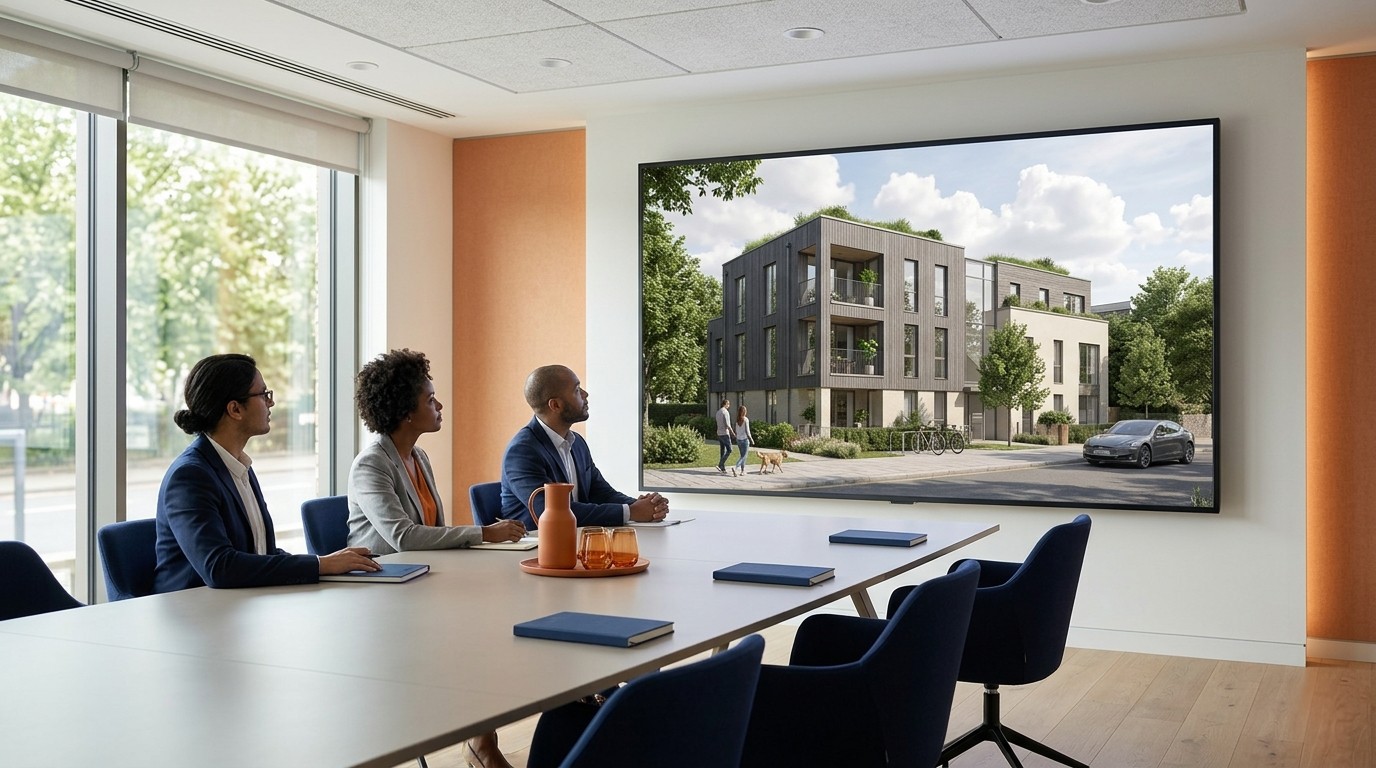
Planning applications are won and lost on communication. The most technically sound design can be rejected if the planning committee can't understand what they're looking at. Conversely, a well-presented scheme that's easy to visualise has a significantly better chance of gaining approval, even when the underlying design is no more technically accomplished.
3D visualisation has become one of the most effective tools for bridging this communication gap. Here are five specific ways it improves your chances of a successful planning outcome.
1. Making the Intangible Tangible
Most planning committee members are not architects or designers. They're councillors, community representatives, and local residents who may have limited experience reading 2D technical drawings. Floor plans and elevations, no matter how well drafted, require a degree of spatial imagination that not everyone possesses.
A photorealistic 3D render removes this barrier entirely. When committee members can see exactly what a building will look like, its proportions, materials, relationship to neighbouring properties, they can form an informed opinion without needing to interpret abstract line work.
This alone significantly reduces the likelihood of refusal based on misunderstanding rather than genuine design concerns.
2. Demonstrating Contextual Fit
One of the most common reasons for planning refusal is concern about how a development will fit within its surroundings. Will it tower over neighbouring houses? Will it block light? Does the material palette complement the existing streetscape?
3D visualisation answers these questions visually by placing your design in its actual context. Using site photography and accurate measurements, the proposed building can be shown alongside existing structures, demonstrating:
- Scale relationships with neighbouring buildings
- Shadow and daylight impact at different times of day
- Sight lines from key viewpoints (streets, neighbouring gardens, public spaces)
- Material and colour compatibility with the surrounding area
This contextual evidence is far more persuasive than written descriptions or 2D overlays.
3. Engaging the Community Early
Many local authorities now encourage or require pre-application community consultation. This is your opportunity to build support before the formal planning process begins.
3D renders make community engagement far more productive. When residents can see what's actually being proposed, rather than trying to interpret architectural drawings, conversations become more constructive. Concerns can be addressed specifically, and the design can be refined based on genuine feedback rather than abstract fears.
Developers who invest in quality visualisation for community consultation consistently report smoother planning processes and fewer objections at the formal application stage.
4. Supporting Design and Access Statements
Every planning application includes a Design and Access Statement explaining the rationale behind the proposal. 3D visualisation strengthens this document by providing visual evidence for the claims it makes.
When your statement says the development responds sensitively to local character, an aerial 3D view showing the building within its streetscape context makes that claim verifiable. When you describe the quality of materials, a close-up render showing texture and detail gives the committee confidence in the finished result.
Visual evidence carries more weight than written assertions because it can be evaluated directly rather than taken on trust.
5. Reducing Conditions and Revisions
Even when planning permission is granted, it often comes with conditions that require further submissions, details of materials, boundary treatments, landscaping, and more. Each condition adds time and cost to the project.
High-quality 3D visualisation can pre-empt many of these conditions by demonstrating design intent clearly from the outset. When the committee can see the proposed materials, landscaping, and boundary treatments in context, they're more likely to approve these elements as part of the original application rather than deferring them to conditions.
Similarly, when design intent is clearly communicated, there's less risk of being asked to revise and resubmit, a process that can add months to a project timeline.
What Makes an Effective Planning Visualisation
Not all 3D renders are equally useful for planning purposes. The most effective planning visualisations share several characteristics:
- Accuracy over artistry, Planning committees need to see what the building will actually look like, not an idealised version. Accurate proportions, realistic materials, and honest representation of the surroundings are essential.
- Multiple viewpoints, Show the development from key vantage points: the street approach, neighbouring properties, and any sensitive viewpoints identified in your planning assessment.
- Existing context, Always show the development alongside existing buildings and landscape. An isolated render of the building floating in space is far less useful.
- Consistent lighting, Use realistic lighting conditions that match the site's orientation. North-facing elevations should look different from south-facing ones.
Need 3D Visualisations for Your Planning Application?
We create accurate, compelling renders that help your designs gain approval.
Get a Free QuoteThe Return on Investment
The cost of professional 3D visualisation is modest compared to the potential cost of a planning refusal, which can include redesign fees, resubmission costs, delays to construction programmes, and in some cases, the loss of the project entirely.
For most developments, investing in quality visualisation at the planning stage is one of the most cost-effective decisions a developer or architect can make. It improves the quality of the application, reduces the risk of refusal, and accelerates the path from consent to construction.