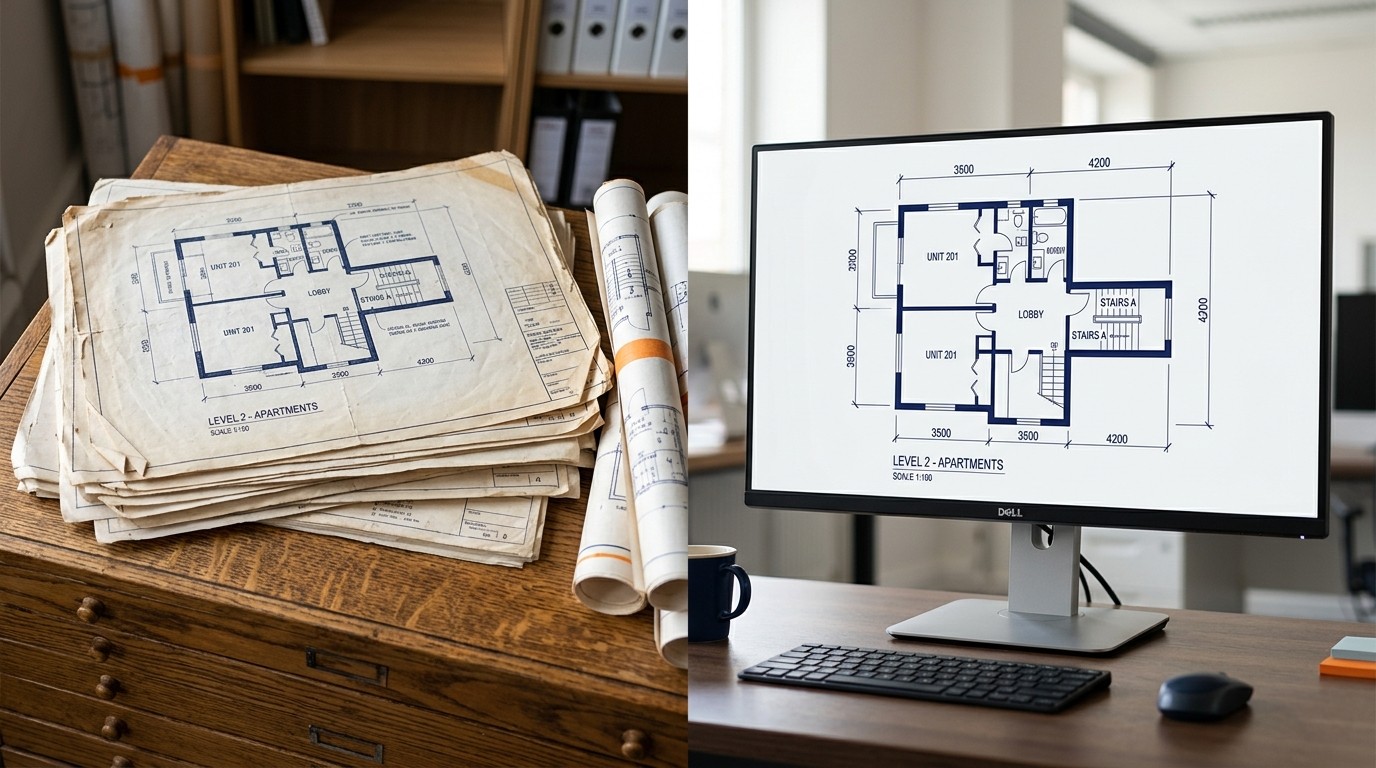
The Shift from Paper to Digital
The construction, architecture, and engineering industries have undergone a fundamental transformation over the past two decades. Where once every office had rows of plan chests filled with hand-drawn blueprints, today's firms rely on digital CAD files that can be shared, edited, and archived with a few clicks.
Yet many companies still hold thousands of paper drawings in storage. These legacy plans represent years of valuable design work, but in their current format, they're increasingly difficult to use, share, and protect. The question is no longer whether to digitise, but when and how.
The Real Cost of Keeping Paper
Paper drawings come with hidden costs that many firms underestimate:
- Physical storage, Plan chests, filing rooms, and off-site storage all cost money. As your archive grows, so does your overhead.
- Retrieval time, Finding a specific drawing from a decades-old project can take hours. In a digital system, it takes seconds.
- Deterioration, Paper degrades over time. Moisture, light, and handling all take their toll. Once a drawing is damaged, that information may be lost forever.
- Collaboration barriers, Paper drawings can only be in one place at a time. Digital files can be accessed simultaneously by team members across different locations.
- Revision tracking, With paper, tracking changes between drawing revisions means physical mark-ups and re-draws. CAD software handles this natively.
What Digitisation Actually Means
Paper to CAD conversion is more than simply scanning a drawing into a PDF. While scanning creates a raster image (essentially a photograph of the drawing), true CAD conversion produces a fully editable vector file. This means:
- Every line, dimension, and annotation becomes an independent, editable object
- Layers can be organised by discipline (structural, electrical, plumbing, etc.)
- Measurements can be extracted and verified directly from the file
- The drawing can be modified, extended, or integrated into new projects
- Output formats include DWG, DXF, PLN, and more
This is a fundamentally different product from a scanned image, and it's what makes the conversion truly useful for ongoing design and construction work.
The Measurable Benefits
Firms that have digitised their drawing archives consistently report significant improvements across several key areas:
Speed
Accessing a drawing from a digital archive takes seconds rather than hours. When a client calls with an urgent question about a property built 15 years ago, you can pull up the plans immediately instead of sending someone to dig through storage.
Accuracy
Professional CAD conversion, when done manually by experienced drafters, produces files that faithfully represent the original drawings. Unlike automated tracing tools, manual conversion captures the intent behind each line, correctly interpreting symbols, annotations, and dimensional relationships.
Cost Reduction
The upfront cost of conversion is quickly offset by reduced storage costs, faster project turnaround, and the ability to reuse existing drawings as the basis for new work rather than starting from scratch.
Risk Mitigation
Digital files can be backed up to multiple locations, eliminating the risk of losing irreplaceable drawings to fire, flood, or simple deterioration. For firms with regulatory obligations to retain drawings, this is not just convenient, it's essential.
When to Start
The most common approach is to begin with the drawings you need now. Rather than attempting to digitise an entire archive at once, many firms adopt a pragmatic strategy:
- Active projects first, Convert drawings for any project currently under construction or in design development.
- High-demand archives, Identify which historical projects are most frequently referenced and convert those next.
- Bulk digitisation, Once you've established a workflow and a trusted conversion partner, work through the remaining archive in batches.
This phased approach spreads the cost over time and delivers immediate value from day one.
Choosing the Right Conversion Partner
Not all conversion services are equal. The key factors to evaluate include:
- Manual vs automated conversion, Automated tracing tools produce inconsistent results, especially with older or complex drawings. Manual drafting by experienced professionals ensures accuracy.
- Format flexibility, Your partner should deliver in the formats you need: DWG, DXF, PLN, or others.
- Quality guarantee, Look for a provider that stands behind their work with a satisfaction guarantee and free corrections.
- Turnaround time, Depending on your needs, standard delivery of 3-5 days or express options should be available.
- Security, Your drawings may contain sensitive project data. Ensure your partner has appropriate confidentiality measures in place.
Ready to Digitise Your Drawings?
Get a free quote for your paper to CAD conversion project.
Get a Free QuoteLooking Ahead
The trajectory is clear: digital drawing management is becoming the industry standard, not the exception. Building Information Modelling (BIM), cloud-based collaboration platforms, and increasingly strict regulatory requirements all assume digital as the baseline.
Firms that delay digitisation will find themselves at an increasing disadvantage, unable to collaborate efficiently with partners who have already made the switch, and spending ever more time and money maintaining paper archives that serve fewer and fewer practical purposes.
The good news is that getting started is straightforward. With a reliable conversion partner, a clear prioritisation strategy, and a commitment to working digitally going forward, the transition from paper to CAD can be completed without disrupting ongoing projects.