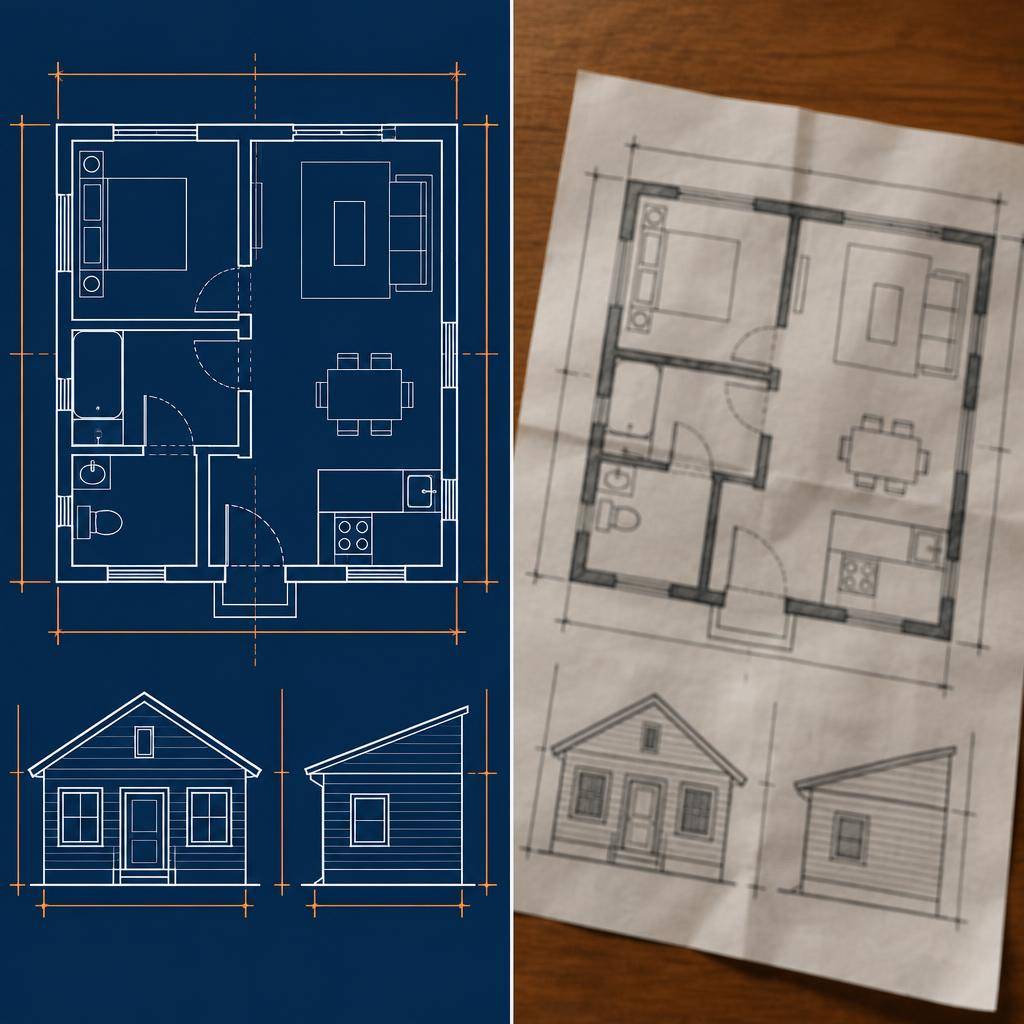
We've all been there. You're on site, you need a record of a drawing, and your phone is in your pocket. A quick photo seems obvious. For a visual reference, it works. But the moment you need to take measurements, scale the drawing, or convert it to CAD, the problems show up.
Large format scanning exists for good reason. The difference between a phone photo and a proper scan is not just image quality. It's about creating a file you can rely on for technical work, accurate measurement, and processes like CAD conversion.
The problem with phone photos of drawings
Taking a photo of a drawing introduces variables that hurt accuracy. Even if the image looks sharp on your screen, the geometry is rarely trustworthy.
Perspective distortion
Unless your phone is exactly perpendicular to the drawing, with the lens centred over the sheet, you'll capture perspective distortion. Parallel lines won't stay parallel. Dimensions at one end of the sheet will be at a different scale than dimensions at the other end. For an A0 or A1 drawing, achieving perfect alignment by hand is nearly impossible.
Inconsistent lighting and shadows
Ambient lighting creates uneven exposure across the drawing. Shadows from your hands, body, or objects in the room can obscure detail. Reflections from glossy or laminated sheets create bright spots that wash out line work. Fluorescent or LED lighting can introduce colour casts that reduce contrast between the drawing and its background.
Resolution and detail loss
Phone cameras are built for everyday photography, not technical documentation. Modern phones have high megapixel counts, but those pixels are spread across the entire frame, including borders, backgrounds, and wasted space. The actual resolution capturing fine line work on the drawing itself is often too low for precise work. Thin lines blur together, annotation becomes illegible, and dimension text is harder to read.
No dimensional accuracy
A photograph captures a two-dimensional representation of a drawing, but without a controlled, flat scanning bed and calibrated optics, there's no guarantee of dimensional accuracy. If you try to scale a phone photo and take measurements from it, you're building on an unstable foundation. Small errors compound quickly, especially on larger sheets.
What large format scanning does
A large format scanner is a precision tool designed to capture technical drawings with accuracy and consistency.
Controlled, flat capture plane
Large format scanners hold the drawing completely flat against a glass platen or feed it through calibrated rollers. This means the entire sheet is captured in the same plane, which removes perspective distortion. Every point on the drawing is scanned at the same distance from the sensor.
Calibrated optics and sensors
Scanners are calibrated to reproduce dimensions accurately. When you scan an A0 drawing at 300 DPI, you know precisely how many pixels represent each millimetre on the original sheet. This makes the file suitable for scaling, measurement, and conversion to CAD.
Consistent, diffuse lighting
Scanners use built-in, evenly distributed light sources that illuminate the drawing uniformly. There are no shadows, no hotspots, and no reflections. The result is a clean, high-contrast image where line work is crisp and text is legible.
High true resolution
A scanner's resolution applies to the entire drawing area, not just the portion that happens to be in focus. Fine detail is preserved across the whole sheet, making the scan suitable for zooming, printing, and technical analysis. Our scanning DPI calculator shows which resolution suits archiving, CAD conversion or printing.
When a phone photo might be acceptable
There are limited cases where a phone photo is adequate, and it's worth acknowledging them.
- Quick visual reference: If you need to remember what a drawing looks like or show a rough layout to a colleague, a photo serves that purpose.
- Non-critical communication: Sharing a quick image in an email or message to provide context, where precise detail isn't required.
- Temporary placeholder: If you're waiting for proper scans to be completed but need something immediately to remind you of the drawing's content.
What a phone photo is never suitable for:
- Taking measurements
- Scaling or georeferencing
- Conversion to CAD
- Archive or records management
- Printing or reproduction
- Any work requiring dimensional accuracy
Why accuracy matters for CAD conversion
If your end goal is to produce a CAD file from a paper drawing, the quality of your source scan is critical. We manually draft every line, arc, and annotation from the scanned image. The clearer and more accurate that image, the more faithful the CAD file will be to the original.
Readable dimensions and annotations
CAD conversion relies on being able to read dimension text, notes, and annotations clearly. Blurred or low-resolution text slows down the drafting process and increases the risk of errors. A proper large format scan ensures every piece of text is legible, even at small font sizes.
Accurate scaling
We use the stated scale on the drawing to set up the CAD file correctly. If the scan is distorted or dimensionally inaccurate, we can't rely on measurements taken from it. A calibrated scan allows us to verify the scale and ensure the CAD geometry matches the original drawing precisely.
Clean line work
Manual CAD drafting involves tracing over scanned line work. Crisp, high-contrast lines make this process faster and more accurate. Blurred or faint lines from a poor-quality image lead to ambiguity and require more interpretation, which can introduce errors.
The hidden costs of poor quality scans
Choosing a phone photo over a proper scan might save a few pounds upfront, but the costs add up downstream.
Rework and corrections
If a CAD file is drafted from a poor-quality image, discrepancies and errors are more likely. Correcting those errors takes time, and if the work has already progressed to the next stage, the cost of rework increases.
Delayed projects
Illegible or ambiguous drawings slow down every process that depends on them. Whether it's planning applications, construction drawings, or facilities management, unclear source material creates bottlenecks.
Loss of trust and professional reputation
Submitting poor-quality documentation to clients, contractors, or authorities reflects poorly on your work. In fields like architecture and engineering, attention to detail and quality control are expected.
What to expect from large format scanning
When you send drawings to us for scanning, we handle sheets from A2 up to A0. Each drawing is scanned at high resolution and delivered as a PDF, JPEG, or TIFF, depending on your preference.
Turnaround and collection
We confirm the turnaround for your volume of drawings when we quote. If you're in Warwickshire, we offer drop-off and collection to make the process as convenient as possible.
Optimised file output
We deliver files that are ready to use. PDFs are optimised for file size without sacrificing quality, making them easy to share, store, and print. If you need the scans as a basis for CAD conversion, we ensure they're captured at the resolution and format best suited to that process.
Secure handling
We're registered with the ICO and treat all drawings with confidentiality and care. Whether you're scanning historical records or current project documents, we understand the sensitivity and value of your material.
Choosing the right approach for your project
If you're managing a set of drawings and deciding how to digitise them, consider what you'll actually need to do with the files. A phone photo might seem convenient, but if there's any chance you'll need to measure, scale, print, or convert those drawings, it's worth investing in proper large format scanning from the start.
The cost is modest, especially compared to the time and expense of dealing with unusable files later. For drawings that matter, quality is the foundation of everything that follows.
If you'd like to discuss your scanning requirements or get a quote for a set of drawings, we're here to help. Our team in Leamington Spa has converted more than 10,000 drawings for architects, engineers, surveyors, and property professionals across the UK.
Need Help With Your Drawings?
Paper to CAD, large format scanning, 3D visualisation and digital floor plans, 48-72h turnaround.
Get a Free Quote